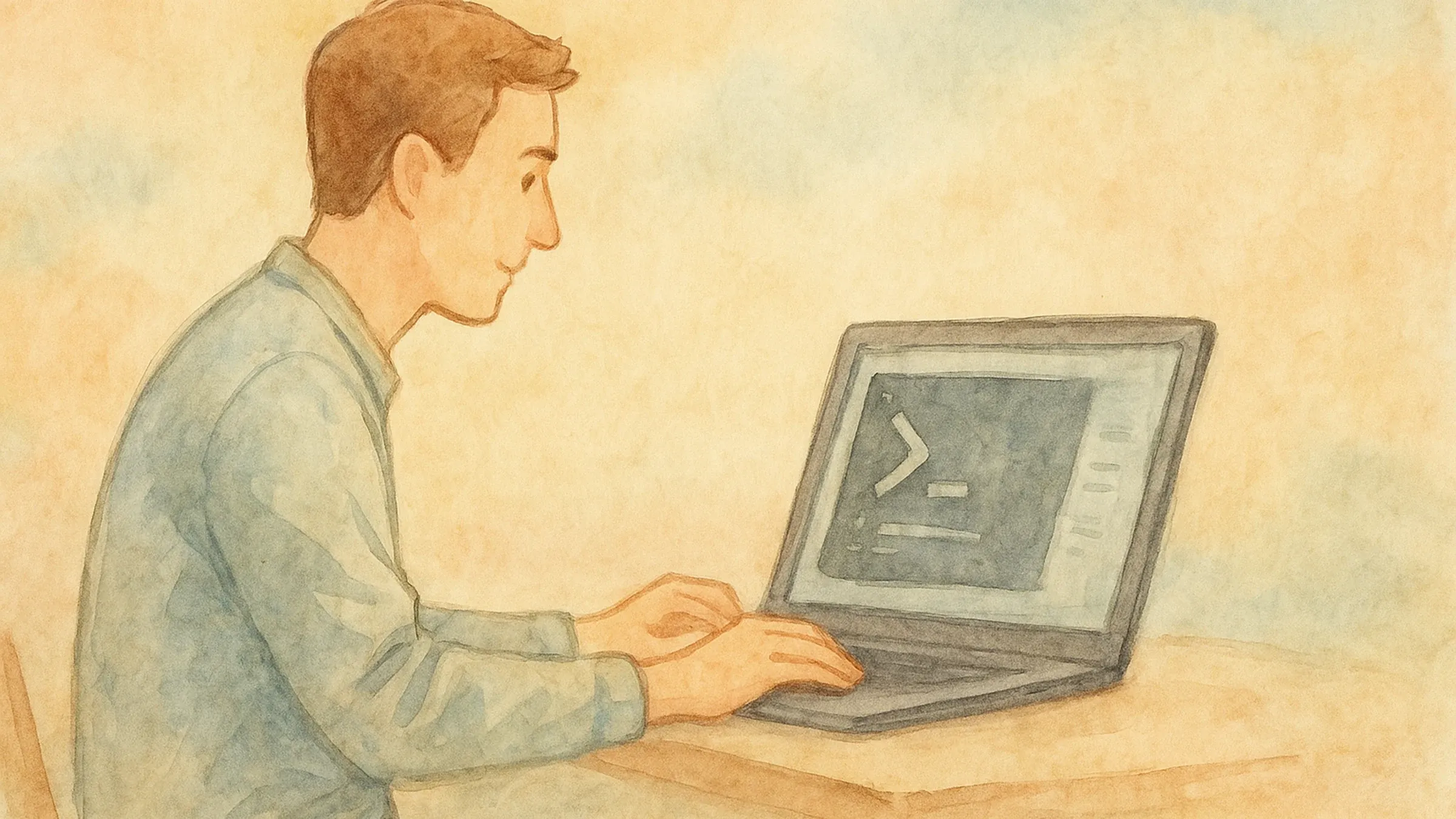
I Tried Claude Design. My Terminal Already Does It.
Recently I’m working on a project where the front end part is very important. It should be consistent. It should feel like one thing, not like ten screens created by ten different people after too much coffee.
And the funny part is: I’m enjoying the design thing. I don’t have a designer, which is fine. That’s part of my journey of being a product builder. When you build products alone, or almost alone, design is not “someone else’s job” anymore.
The Old Designer Problem
When I worked with designers, they used to create multiple versions. Maybe the sidebar is better on the right side. Maybe on the left side. Maybe this card should be more compact, or maybe it needs more breathing space.
And then you have three mockups in front of you and you need to decide. Which is not always easy, because sometimes you don’t know until you see it inside the real product. Not in a perfect static image, but in the actual flow.
So recently I had the same problem. I was not able to decide. I asked Claude to do what a designer would have done for me: “I can’t decide. Please create at least three mockups so I can decide while you do the development.” The interesting part is not that Claude created variations; the interesting part is that it changed the way the work moved forward.
Claude Is Getting Better At The Flow
Before, Claude used to create three different variations, ask me to choose, and then create the plan. Which was already useful, okay. But it was still a bit step by step: first mockups, then decision, then plan, then development.
This time was different. Claude created the plan, created the variations, started developing, and while developing it allowed me to decide which variation I wanted. Then it automatically updated the execution plan based on my choices.
That was the moment where I said, okay, this is becoming really useful. Not because it did some magic. But because it behaved more like a real product teammate. It kept the plan alive while the product was changing.
In this case, I needed to decide between several places in the UI. Claude created an artifact with three variations for each one: A1, A2, A3, B1, B2, B3, C1, C2, C3. And because I’m usually speaking instead of typing, it was very easy for me to just say: “I prefer A1, B2, C3.” This is the kind of interaction that makes AI coding feel less like prompting and more like building.
I Tried Claude Design
I know that Anthropic created Claude Design. I tried it. And to be honest, I don’t think it fits my need in this case.
Maybe because I already created my design system. Everything is already in the repo. The components, the structure, the rules, the way the product should look. So for me, moving outside that flow doesn’t help so much.
This is something I’m seeing more and more with AI tools. A lot of packaged functionality is basically a better, cleaner, more friendly version of something you can already do with the terminal, good files, and a well-organized repository. I’m not saying it’s bad. I’m saying that if your setup is already solid, the terminal can already do a lot.
That’s also why I care so much about the stack and the workflow around it, not only the shiny feature. I wrote about my AI coding stack because the tool is only one part. The repo, the context, the files, the way you organize decisions — that’s where the leverage is. Claude Design is nice, but for my current way of working, Claude inside the repo is more useful.
From Full Stack To Product Builder
I remember before we were called full-stack engineers. Front end, back end, database, deployment. You were the person who could move across the stack and ship the thing.
Now I think the shape is changing. Product builder is something different. It’s still engineering, of course. But it also includes design taste and product thinking. You need to decide what makes sense, not only how to implement it.
And yes, sometimes that means accepting that the first version is not perfect and moving anyway. I wrote about this idea in imperfection is the new lean, because this is exactly the point: you don’t wait for the perfect process, the perfect designer, the perfect mockup. You build, you look, you decide, you adjust.
For me, a product builder today is the combination of three pillars: design, product thinking, and engineering development. Maybe Claude Design is useful for many people. For me, right now, the terminal plus a good repo is already the place where those three things meet.
I love feedback.
Did this help? One tap — that's it.
Thanks 🙏
Want to add anything — or get in touch? Totally optional.
Got it — thank you. 🙏
Keep reading
GSD (Get Shit Done): The Framework That Changed How I Build Serious Software With AI
A deep dive into the GSD plugin for structuring multi-phase software projects with LLMs, from planning to autonomous execution and testing.
I Vibe Code Every Day Without an Engineering Team. Here Are the 3 Modes I Switch Between
Three modes of AI coding—auto-edit, planning, and GSD—and how matching the mode to the task drives better results without an engineering team.
Alessio's G-SEO Suite: One Google App So My Scripts Can Read (and Fix) My SEO
The companion to Alessio's G-Suite: one private Google app for Search Console, Analytics and Tag Manager, with write access on purpose — because read-only is comfortable, and write is where the time saving is.