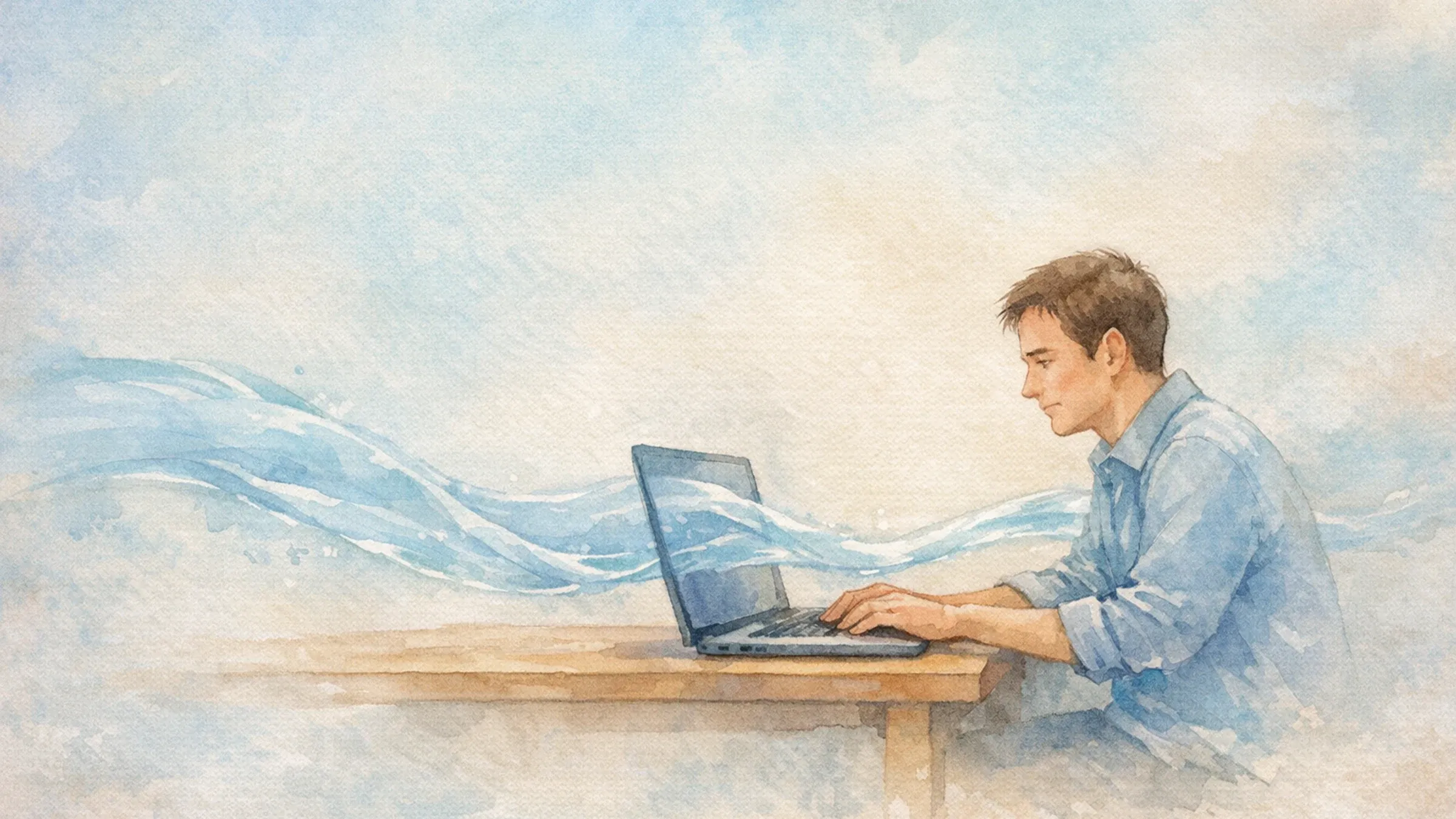
A Watermark Tells You Where a Text Passed Through. Not How Much Human Thinking Is Inside.
This morning, the email
This morning I received an email from Claude with this subject: “[No Action Required:] Text watermarking begins November 3, 2026 on some models”. My first thought was stupid and normal at the same time. Watermark, for me, was a stamp. A logo. Something visible on top of the text, like when you download an image from somewhere and it screams “you didn’t pay for this”.
Then I asked Claude to dig into it with me, and the first funny thing we found is that the raw email was full of invisible characters. But no, that was not the watermark. Those invisible characters were just standard email preheader padding, the little trick emails use to control the preview text in your inbox. The email itself says the watermark “adds no characters or tokens”. So the watermark is not in the bytes, not in some hidden character, not in a secret stamp.
The watermark lives in the word choices, and this is exactly why I went studying it.
Because this is the era we are living in. You receive an email in the morning, you think you understand the words, then you realize you don’t. And even staying updated is sometimes not enough, because while you are reading one thing, three other things already changed behind your back.
A tiny rejection email, because why not
Let’s make it concrete. Also, because I’m job hunting right now, let’s use the most romantic sentence of this period: “Thank you for your interest. Unfortunately, we have decided to ___”. Beautiful. Poetry. Give me a coffee and a wall to stare at.
Now imagine the model has a few possible endings. These numbers are completely made up for the example: “move forward with other candidates” 40%, “pursue other candidates” 30%, “proceed with other applicants” 20%, “not move forward” 10%. Normally the model rolls the dice using those odds. It picks something that makes sense, based on probabilities.
With watermarking, there is a secret key, only the provider has it. The key plus the previous words gives each possible next piece of text a hidden score. Some options become slightly favoured, some not. The model still chooses a perfectly fine answer, but it leans a tiny bit toward the favoured ones. Not enough that you read it and say “ah, watermarked”. Enough that, after many choices, a detector can see the pattern.
One word tells you nothing; many words start to tell a story.
Think about a coin that lands heads 55% of the time. One flip means nothing. Ten flips still maybe nothing. A thousand flips, and now you start looking at it differently. The detector re-runs the math with the key and counts how often the text lands on the favoured side. Human text lands there about half of the time by chance. Claude text lands there too often.
Where the magic breaks
The first place where this breaks is code. In code, many times there is only one right token, or a very small number of reasonable ones. You don’t have much freedom to tilt. An independent paper found detection near chance on code, which is not exactly shocking if you ever tried to write code where a missing bracket ruins your day.
Short text is another problem. Too few coin flips. The EU code of practice only asks to watermark text over 200 tokens, which makes sense because below that you are trying to detect a pattern from almost nothing.
Then there is paraphrasing, translating, heavy editing. Every word you change removes a flip from the original sequence. OpenAI’s own test showed that replacing 10% of words with synonyms dropped detection from about 92% to 66%. Copy-paste and light edits may survive, but the more you transform the text, the more the signal gets damaged.
The funny part is that the more human work you put back into the text, the less the watermark can tell the full story.
Who is marking what
| Provider / model | What happens |
|---|---|
| Claude | Every model launched after August 2, 2026 is watermarked. Applies worldwide across API, Claude apps, Claude Code, Cowork, and also through AWS, Google Cloud, Microsoft Foundry. No opt-out mentioned. |
| Older Claude models | Claude Mythos 5, Claude Opus 4.7, Claude Opus 4.6, Claude Sonnet 4.6 join on November 3, 2026. For Opus 4.6 and Sonnet 4.6, only with default temperature/top_p/top_k. |
| OpenAI | textGrain, announced in October 2026, in the EU only, for ChatGPT and Codex. API off by default, unless developers enable it for select models. |
| SynthID-Text in Gemini since 2024. | |
| Open-weight models on your laptop | Nobody can centrally enforce marking, and the mechanism can be removed. |
The catch is that normal people cannot really check any of this today.
Anthropic text detection is in private preview for eligible organizations: regulators, law enforcement, media, fact-checkers, researchers, educational organizations, EU civil-society groups, and enterprises with compliance duties. OpenAI also starts with approved researchers and expert organizations. So we are creating marks that most people cannot verify, inside systems most people cannot inspect. That’s a very IT way to solve a human problem.
My mixed feeling
I’m not against watermarking. Really. If a text was produced by Claude, or processed by Claude, I think it is fair to have a way to say it. We are already living in a world where content is cheap, infinite, and sometimes completely detached from a human who actually thought something.
But what I don’t like is the market trend around it. The little voice behind the technical solution. “You did it with Claude, so it is less valuable.” And because it is less valuable, you are replaceable. I wrote once that AI won’t replace you unless you allow it to, and I still believe it. But I see this trend every day while job hunting. Every day it feels harder.
The risk is that the watermark becomes another excuse to reduce the human behind the work.
Samuel East wrote a post after being laid off from Plex roughly 60 days after starting, after an earlier redundancy. I don’t want to use that to blame Plex or pretend I know the inside story, because I don’t. But two lines hit me hard: “We’re moving from writing and understanding code to managing prompts, reviewing AI-generated solutions” and “What exactly are we measuring engineers against anymore?”
That is the point. At least in the eyes of some companies, we became the ones who give the prompt and nothing more. The funny part is done by agents. Humans are there to ask, review, fix, ask again. Until maybe agents start prompting themselves, and then what? Who controls who?
Maybe this sounds apocalyptic. Maybe it’s my morale. Maybe because I’m in the middle of applications and rejections, and you start seeing every trend through that lens. But I see companies asking more from humans every day and recognizing less to those same humans. That is not great for everybody. Actually, it is not great for humanity.
Regulation helps, but holy shit
The good part is that someone is trying to regulate. The email exists because of a law. The EU AI Act says providers must mark AI-generated text, images, audio, and video “in a machine-readable format and detectable as artificially generated or manipulated”. So yes, regulation can work, at least enough to make big providers move.
But we are in IT, and IT is a fucking nightmare to regulate. Open-weight models can run locally. The mechanism can be removed. Paraphrasing can damage the signal. Detection is private, so neither vendor claims nor user fears can really be verified from outside today. We create a rule, then reality immediately finds twenty little doors around it.
We are using regulation to chase a technology that is already running faster than the people trying to understand it.
And maybe this is the part that bothers me more. We are losing an opportunity to slow down as humans. To say: ok, this is powerful, this is useful, but let’s breathe. Instead, companies look at it as an opportunity to grow faster. Faster than competitors, yes, but maybe also faster than humans.
Even smart people are becoming kind of zombie. Keep up with the new model, the new tool, the new workflow, the new law, the new benchmark, the new “AI-first” expectation. Study every morning just to be a normal professional by lunch. It is fascinating, yes. It is also exhausting.
And now the uncomfortable part
This article was drafted by a model too. Research and fact-checking with Claude. Prose drafted by GPT through OpenAI’s API from my voice note. And on the API, OpenAI’s watermark is off by default, so no mark will ever say it.
And yet the opinion is mine. The job hunt is mine. The mixed feeling is mine. The “holy shit, this is moving too fast” is very much mine. The model helped me shape it, but it didn’t wake up this morning, open the email, think “watermark” meant a stamp, and feel weird about the future of work.
OpenAI itself says watermarks “can indicate that an OpenAI system generated or processed part of a passage, but not how much human judgment” went into it. That sentence should be printed somewhere before we start judging people, candidates, engineers, writers, or whoever. Because the difference between “AI wrote this” and “a human used AI to think, draft, verify, and argue” is not a technical detail. It is the whole damn point.
The laws and references, in short
- EU AI Act — Regulation (EU) 2024/1689, Article 50(2): providers must mark AI-generated text, images, audio and video “in a machine-readable format and detectable as artificially generated or manipulated”. Applies from 2 August 2026.
- Transition: for systems already on the market before 2 August 2026, the marking duty applies from 2 December 2026, agreed in the Digital Omnibus (Freshfields).
- Penalties — Article 99(4): up to €15 million or 3% of worldwide annual turnover, whichever is higher.
- Code of Practice on Transparency of AI-Generated Content — final version published 10 June 2026, voluntary; text over 200 tokens gets watermarked; detection must be interoperable by 2 February 2027. Anthropic, Google, Meta, Microsoft and OpenAI are among those committed to it (Jones Day, TechCrunch).
- Anthropic — How Claude marks AI-generated content, and the free file checker (images, video, audio via C2PA; it does not check text).
- OpenAI — textGrain, EU only.
- Independent research — Watermarks Without Verification: detection near chance on code, and nothing verifiable from outside.
I love feedback.
Did this help? One tap — that's it.
Thanks 🙏
Want to add anything — or get in touch? Totally optional.
Got it — thank you. 🙏
Keep reading
The Day All the AIs Stopped
A movie in my mind: every AI stops working for good, and after the panic comes silence and the real world. It will never happen, and that says a lot about how we are using AI at work.
Please Stop Comparing LLMs With One-Shot Prompts
One-shot prompt comparisons between LLMs are everywhere right now, and they're useless. The problem isn't the model — it's that nobody bothered to write a spec.
What If AI Sat in the Middle of Every Conversation?
A WhatsApp voice message and an old failed startup called Alfred got me thinking: what if AI sat between every sender and every receiver, translating each message into the style the other person actually wants?