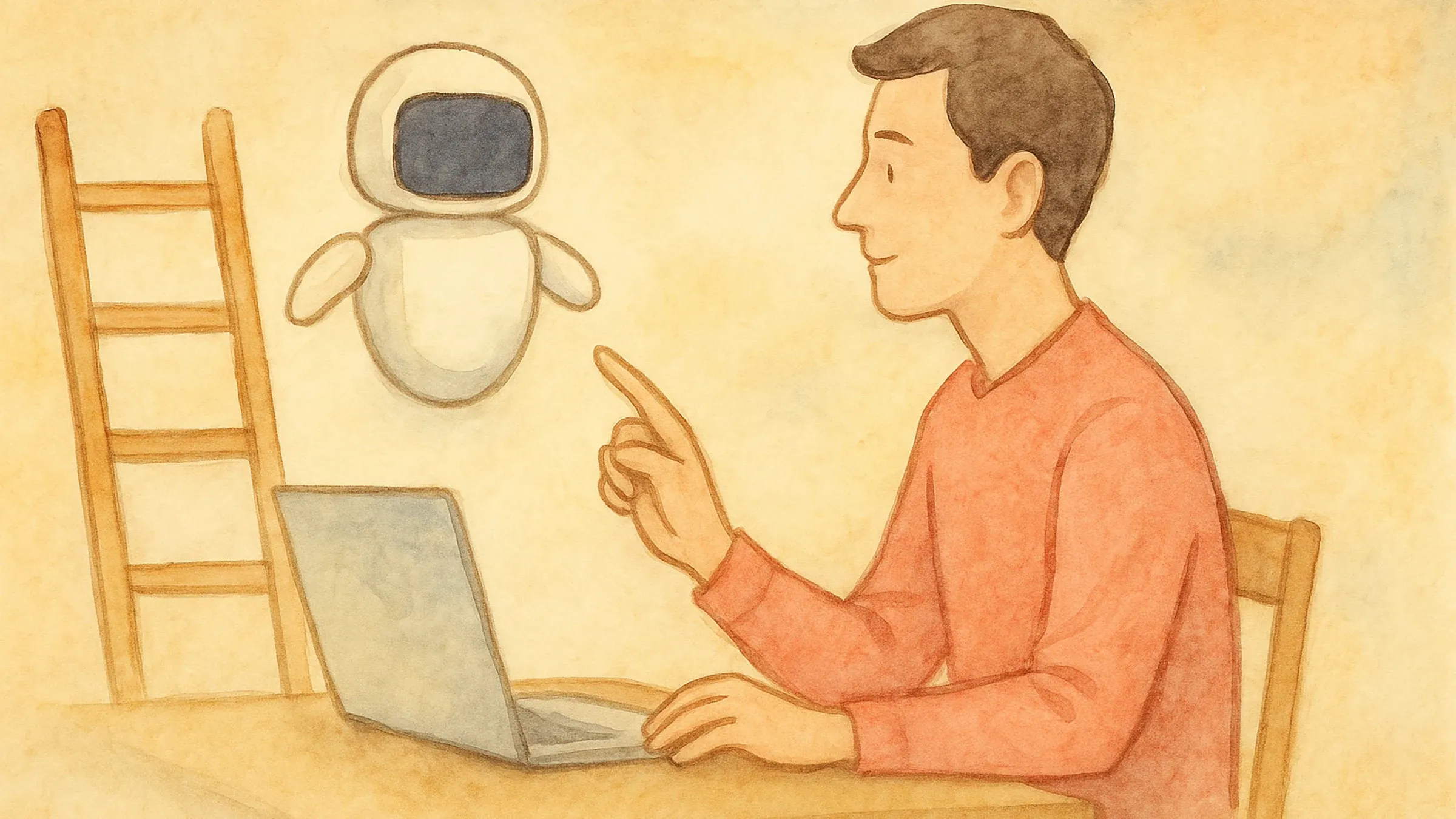
Forget the Ladder: Learning Top-Down in the AI Era
Six months ago I knew not a lot about agentic. I knew the word, I knew the concept more or less, and I knew ElevenLabs by name. That was it. Then a project came to me and I said, “Okay, not a big deal. I will do whatever you need with ElevenLabs.”
Which is a very dangerous sentence, by the way. But also the sentence that made me realize something: the way we acquire knowledge changed. The bottom-up approach is not the only way anymore, and maybe it is not even the best one for a lot of things.
The ladder is how we were trained
The old approach was simple. You study the basics, then the first class, second class, third class, and only after that you start doing complex things. Basically, a ladder. This is how school works, and to be honest, this is how the whole job world worked for a long time.
You learn the foundation. You do the small exercise. You repeat. You wait until someone says you are ready. Then maybe, one day, you are allowed to touch the real stuff. Bottom-up means you need to climb before you can see the view.
And for a long time, it made sense. If you didn’t have access to the knowledge, you needed the path. You needed the teacher, the book, the course, the structure. Otherwise you were lost.
Now you can start from the top
The top-down approach is the opposite. It is only possible now because we have access to world knowledge through LLMs. It’s like being a kid, but instead of going class by class, you are dropped directly inside the university. All the knowledge is there.
But the difference is this: now the teachers can explain it in your own language. If you are six years old, they explain it one way. If you are 40, they explain it another way. If you know software but not hardware, they adapt. If you know product but not agentic, they adapt again.
Top-down means you start from the thing you want to build, and then you go down into the layers only when you need them. This is the mental model that I think we need to change in our brain, because it goes against everything we were trained to do.
My ElevenLabs crash course
So, back to the project. I started from the top. “Hey, I need to create this agent…” and then I went down. I didn’t start with a full course about voice AI, agentic architecture, ElevenLabs, credits, tone, and all the beautiful mess around it.
To be clear, the first agent was not done in one day. Not in two days. I am not selling the magic trick here. But less than six months later, I know a lot about it. Voice, tone, the strange details, the limits, the workflow, how to make things work in the real world and not only in the demo video.
This is very different from how I learned coding. I started coding at 14. After six years, I still didn’t know a lot. I knew something, of course, but it was slow, fragmented, and a lot of times I was just moving in the dark.
Now I am also creating my own A-team. The A can stand for Alessio, because of course, or for Agentic. It is based on four different agents: autonomous, able to escalate to humans when needed, and able to handle things. I wrote more about the agents I built if you want the practical side.
And the funny part is that now I am negotiating with ElevenLabs to increase the plan. We just doubled the credits from 30 million toward 60 million per month, and I believe very soon we will need more than 100 million credits per month. This is not “I watched a tutorial and I feel smart”; this is knowledge acquired while building something that actually needs to survive.
Blinkino, my kids, and the electrician problem
The same thing happened at home, but in a more funny way. I have two kids. Nicholas is seven, and he loves when we do Arduino projects. Thomas is 13, and this year he needs to choose the next school. He thinks he will be an electrician, which for me was a bit… okay, strange.
My first reaction was the classic one. “Okay Thomas, maybe you need to study.” But holy shit, imagine a kid studying to be an electrician from the books. It’s hard. Even starting with Arduino was better, but then the book we had was still too difficult for him.
So now we are creating Blinkino, coming soon on my website. The idea is simple: you start directly from a project, from the top. AI helps you build it, and then you go down the layers based on what your brain needs in that moment. “Show me the pin.” “Show me this in 3D.” “Explain volts and amperes with a metaphor.”
I also have hardware knowledge, but that’s another story. The point is that the project becomes the teacher. The curiosity becomes the path. And yes, I already wrote that schools are missing the AI opportunity, but this is the same idea at home, with cables on the table.
Instead of forcing the kid to earn the project after years of theory, you use the project to unlock the theory.
The scary part
I know this is counterintuitive, especially if you are experienced. Maybe not old, but experienced. We were trained in a different way. My parents’ generation valued education, pedigree, the piece of paper, the fact that you studied the right thing in the right place.
And I am not saying education is useless. That would be stupid. But I believe the attitude of keep learning beats a good pedigree, even a fancy one. Stanford is great, sure. But if you stop learning, what happens five years later?
The scary part is ownership. You need to take responsibility for something you don’t know yet. You need to say, “I don’t know this, but I can enter from the top and learn what I need.” That requires mindset. It requires humility too, because AI will help you, but it will also show you very fast how much you don’t know.
Still, this is the amazing part for me. AI is here to supercharge us. Not to make us lazy, not if we use it in the right way. It can make us more curious, more practical, more able to connect things that before were too far away.
So I’m curious: did you already switch to top-down learning, or are you still trying to climb the ladder from the bottom?
I love feedback.
Did this help? One tap — that's it.
Thanks 🙏
Want to add anything — or get in touch? Totally optional.
Got it — thank you. 🙏
Keep reading

I Used AI to Plan Iceland With Five Friends. The Hard Part Was the Humans.
Five friends, one Iceland road trip, a voting app, three PDFs and AI bookings. AI was the easy part: the real limit was context switching and humans in the loop.
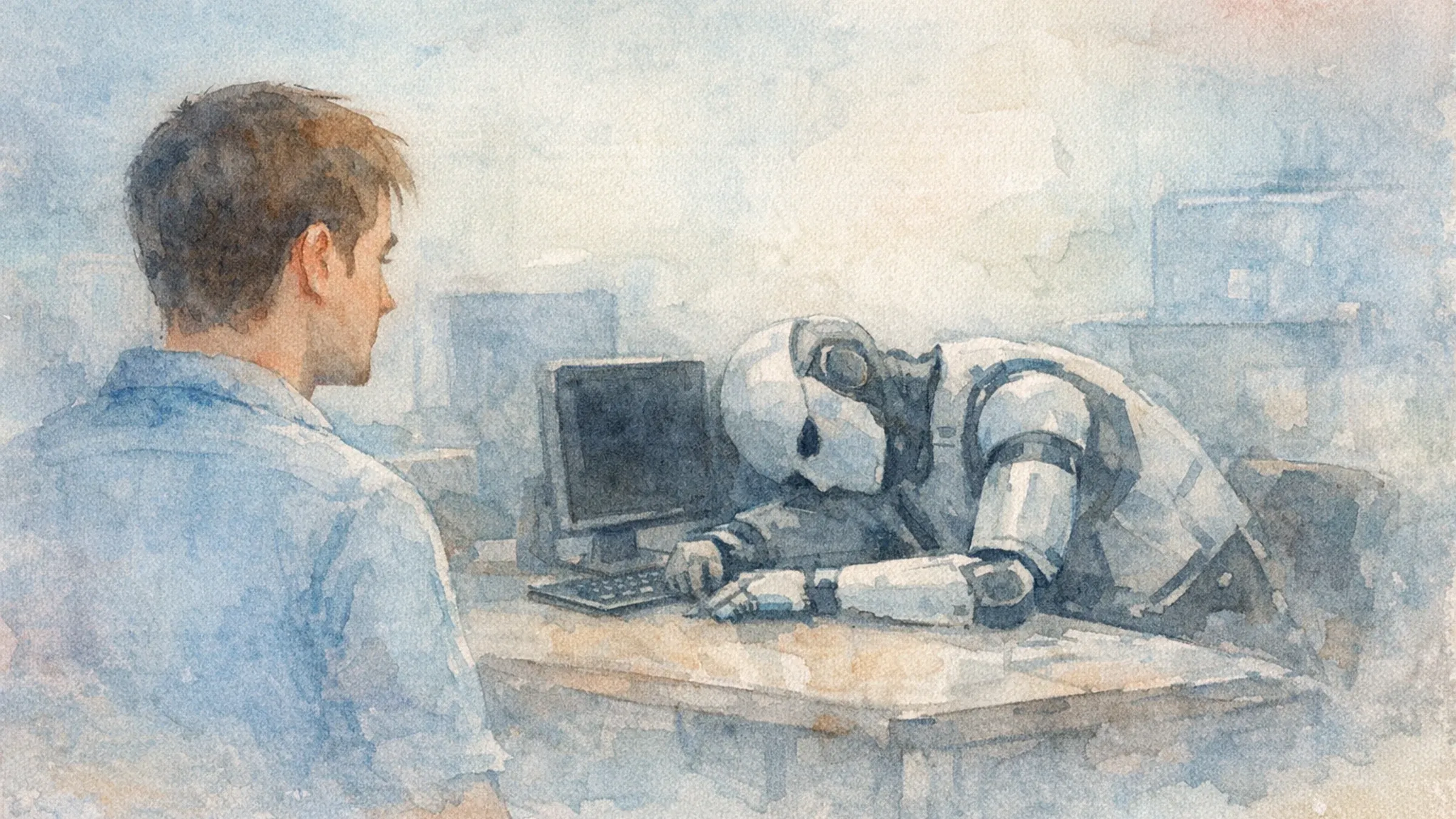
The Day All the AIs Stopped
A movie in my mind: every AI stops working for good, and after the panic comes silence and the real world. It will never happen, and that says a lot about how we are using AI at work.

A Watermark Tells You Where a Text Passed Through. Not How Much Human Thinking Is Inside.
Claude now watermarks every word it writes. I went looking for the stamp: how it really works, where it breaks, and why it leaves me uneasy.