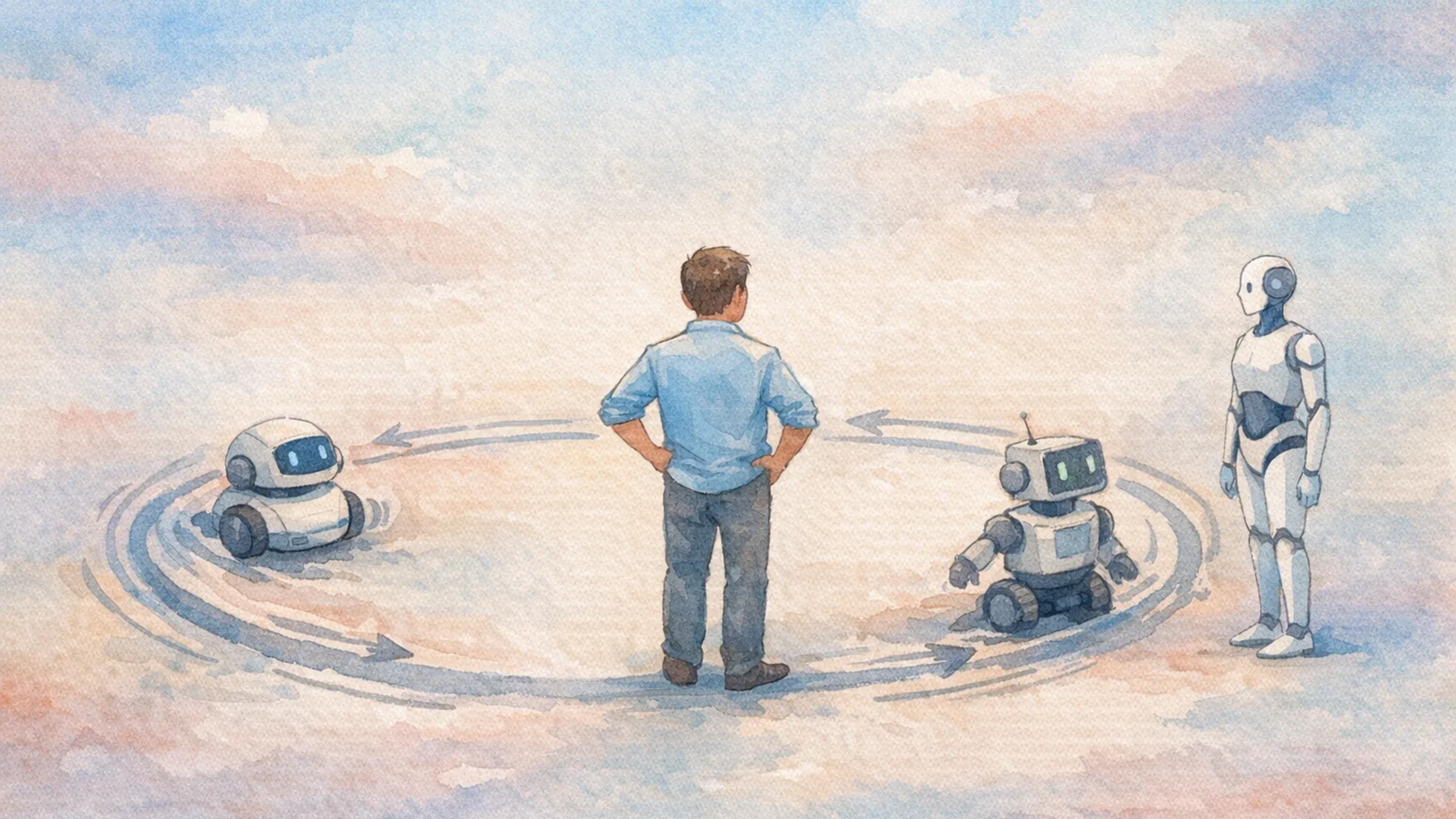
Two Bots Sent Me in Circles. My AI Agent Just Waited.
Sunday I was driving, thinking about Christmas with my family. I wanted to go back to Dolomiti Village, a place I adore and already stayed at. So I dictated to my agent — with my WhatsApp connector and email wired in — “ask them if they have availability, use WhatsApp or email, it’s up to you.” I wanted the model to choose.
It chose WhatsApp, sent the message, and said “done”. A reply arrived immediately: “Ciao! Sono Marta, l’assistente virtuale di Dolomiti Village.” Marta said for Christmas and New Year, write an email. Holy shit.
So I prompted again: “they replied, send an email — but ask me for confirmation first”. The agent drafted it, asked, I confirmed, and the email went out. Then the autoresponder came back: we’ll reply within 24 hours; need a quick answer? Write to us on WhatsApp. WhatsApp bot → email → email bot → WhatsApp. Two bots sending me to each other, and now I am the one checking WhatsApp and email.
What I wanted was one prompt: “this is my goal, get all the info from Dolomiti Village for Christmas; get back to me when you have everything.” Then the agent keeps going on WhatsApp, email, maybe even the phone, follows up, deals with their bot or human, and returns only when it has something that counts. Executing the first instruction is not the same thing as chasing the result.
Before you go on: this one is different
Usually I write because I want to share something now. This time I also wrote it for myself, because this field is consolidating right in these weeks and I needed to re-study where we are. Tests and building will come in the next articles, if I get there. This is me mapping the mess before touching the screwdriver.
Also, this article is interactive. I stole the idea, with love, from Bear Grylls’ Netflix show You vs. Wild, where you decide what he does next. Here you decide how deep you want to go.
- Grandma — explain it like to my grandma, metaphors only.
- AI user — you use AI every day.
- Nerd — tech background, you want the specs, maybe you don’t even use AI.
Pick your level below; the buttons are right after this.
The errand boy in the kitchen
If I had to explain this to my grandma, I would say this: today’s AI assistant is a very good errand boy. You tell him, “Go to the post office and send this letter.” He goes, sends it, comes back, and says, “Done.” Beautiful. Very useful.
But then he sits in the kitchen. Quiet. Hands on the table. Waiting for you to tell him the next thing.
That is exactly what happened with Dolomiti Village. My assistant wrote on WhatsApp, the little robot receptionist answered, “Please write an email.” Then my assistant stopped. I had to tell him, “Ok, now write the email.” Then the email robot answered, “Thanks, we will reply. If you need a quick answer, write on WhatsApp.” So now I am in the middle, like an idiot, watching both doors.
Today these assistants execute very well, but they don’t take care of it.
And that is the difference. Big difference. The thing I want is not the errand boy. I want the old family friend. The one you tell, “Can you find out if they have a chalet for Christmas?” and she says, “Leave it with me.” Then she calls, writes, insists, calls again, maybe complains a little because Italians know how to do that professionally, and comes back only when she knows the answer.
Two receptionists pointing at each other
The funny part is that the two bots were not even wrong. The WhatsApp one said, “For Christmas and New Year, write an email because a human has to check.” Fair. The email one said, “We received your message, we will answer, and if you need something fast, write on WhatsApp.” Also fair, if you look at it from their little desk.
But from my side, this is like entering a hotel and finding two receptionists. One says, “Ask the other desk.” The other says, “For a faster answer, ask the first desk.” Meanwhile I am standing there with my luggage, my kids, and the mental picture of the chalet I want, wondering why I am the one doing the coordination.
The missing piece is not sending the first message; the missing piece is staying on the problem until there is an actual answer.
And for this kind of thing, come on, it is not rocket science. I am not asking the assistant to decide my life. I am asking: do they have a chalet for those days, yes or no? If nobody answers, ask again later. If WhatsApp sends you to email, use email. If email sends you back to WhatsApp, maybe try the phone. Bring me something that counts.
The new assistants are better, but still not that friend
Now, to be fair, the big companies are moving. Meta has Muse, OpenAI has Dots, Anthropic has Duet, and xAI has Grok Bot. In grandma language, the errand boy has started to pop into the kitchen every few hours and ask, “Anything new?” That is already better than sitting there forever.
Some of them can look at your mail, your calendar, your messages, or even call a business. But most of them also stop and ask, “Can I send this?” before doing anything important. And honestly, I get it. If an assistant acts in your name, it can also make mistakes in your name. It can book the wrong week, write the wrong thing, or send a message that sounds like you had three grappas before lunch.
So yes, asking permission is not stupid; it is the safety belt.
The problem is that, from Italy, most of these new things are not even here yet. Meta Muse is not in Europe. Claude Duet is not here. OpenAI Dots, at least on the plan for individuals, is not here either. As far as I can tell, only Grok Bot seems maybe buyable from Italy, and even that is not crystal clear.
So we are in this strange middle moment. The assistants are no longer just toys. They can write, read, remember, click, send, and sometimes call. But when the task is “please take care of this until the human replies,” they still behave more like a polite errand boy than the family friend who knows that the job is not finished when the first letter is posted.
Why the loop didn’t close
The stupid part is that my agent did exactly what I asked. It sent the WhatsApp message. Then, when I told it there was a reply, it wrote the email. Then, when I confirmed, it sent it. From a tool point of view, everything worked.
The loop didn’t close because the agent was not really “there” after the action. MCP, the standard behind many of these connectors — I wrote a more practical explanation here: MCP, skills and commands explained — lets the AI do things when you ask. Call Gmail. Call WhatsApp. Read a file. Use a browser. Whatever the connector exposes.
But MCP, at its core, is pull: the model decides to call a tool, and nothing wakes the model up when a new email or WhatsApp arrives. Tools sit there like a very expensive toolbox. Useful, yes. Alive, no.
That’s why I became the notification system. The WhatsApp bot replied, but my agent didn’t know unless I told it. The email autoresponder replied, same thing. So I was driving, checking WhatsApp, checking email, and then prompting the agent again. Congratulations, Alessio: you built an assistant and hired yourself as the intern.
There is movement here, to be fair. MCP Tasks shipped as an official extension in July, but it’s more “keep working in the background and let the client poll” than “wake up when something happens”.1 The real missing piece is events: push, webhooks, triggers. The official MCP roadmap lists server-initiated events as a priority, but the standard is not there yet.23 OpenAI didn’t wait and shipped its own ChatGPT version of MCP Events on 29 September, with subscriptions, callback URLs, signed events and retries.1
The proactive agents arrived
Now, while I was fighting with Dolomiti Village’s WhatsApp bot and email bot, the whole market basically decided: “Fine, let’s make agents that don’t sleep.” The last three months have been packed.
The new wave: agents with timers, app access, sometimes their own computer, and a habit of asking before doing dangerous stuff. Grok Bot was introduced on 11 August by SpaceXAI, formerly xAI: “a team of always-on agents,” each with its own computer, working inside your apps 24/7, with bots handing work to each other.45 On 25 October, Musk reportedly said it can place phone calls for you and send back a summary, but as far as I can tell this is weakly sourced and not documented by xAI.
Meta Muse launched on 8 September, with its own app and WhatsApp, free to start and paid plans at $20 and $100/month. Meta says 10+ million people set it up in about six weeks, and it can make phone calls to businesses, but it is US and Canada only, not Europe and not Italy.67
OpenAI Dots launched on 29 September at DevDay: always-on agents inside ChatGPT, each with its own cloud computer and browser, connected to 4,000+ apps, monitoring Gmail, Calendar, Slack and messaging you when they need approval.8 On Pro, it is excluded in the EEA, UK and Switzerland, with no date; Business Premium in EU countries has conflicting reports, so I would not bet my Christmas chalet on it yet.9
Claude Duet arrived on 21 October as an Anthropic research preview, built on Opus 5.5. It runs on its own cloud VM with a browser, keeps going when you close the laptop, gives you a short morning brief, checks connected apps every few hours, and asks approval before sending a message, paying, signing a document or deleting a file. US only, Pro and Max, waitlist.10
Then there are the phone-call agents. Instinct, invite-only, gave its agent its own email address in September and launched “Instinct Concierge” on 16 September for some early users: reservations, cancellation lists, billing problems, phone calls to businesses.117 Google’s “Call for Me” landed on 24 September: Gemini phones local businesses for you, but only in the US, in English, on Pixel 11, for paying Gemini users.12
From Italy, today, the situation is less sexy. As far as I can tell, Grok Bot seems to be the only big one you can maybe buy, but I found no confirmation for Italy specifically. Duet, Muse and Dots on Pro have not arrived here.
The other route is OpenClaw: open source, self-hosted, install it yourself, works anywhere, Italy included. It talks through WhatsApp, Telegram, iMessage and Slack, and has a heartbeat every 30 minutes that reads a checklist and stays silent if nothing needs attention. Very cool, but also: if you give an agent your email, WhatsApp and shell, you created a real attack surface; even its own guide recommends an allowlist and a dedicated WhatsApp number.13
Executing is not taking initiative
Here is where I think we mix two things. These agents execute better and better. They can watch apps. They can wake up every few hours. Some can use a browser, a cloud computer, maybe call a business, and then ask you before sending, paying, deleting, signing.
Executing is not taking initiative. Even the best of these systems wakes up on a timer or on an event, checks something, and asks permission. That is already useful, but it is still very different from: “Here is my goal, go chase it across WhatsApp, email and phone, follow up when nobody answers, deal with bots and humans, and come back only when you have the result.”
Booking a chalet is the perfect test case because it is boring in the best possible way. There is no deep strategy. No moral dilemma. No product ambiguity. I want to know if they have availability for Christmas and New Year, what it costs, and what the options are. Keep chatting, emailing or calling until you get the answer.
Coding is different. With code, you have ambiguity everywhere. Humans in the middle. Product decisions hidden inside technical decisions. “Make this better” can mean ten things, and five are wrong. But booking? Come on. This is persistence, not genius.
And yes, I understand why they ask permission. If an agent acts on your behalf, it can bind you. Instinct’s terms say exactly that: what the agent does binds you. So approval is the line between “my assistant drafted a message” and “my assistant committed me to something.”
So do you have to build it yourself?
Today, yes. More or less. If you want the Dolomiti Village loop to actually close, you probably have to write your own agent, wire WhatsApp, email, maybe phone, add state, add retries, add reminders, add approvals, add logs, add safety. And then do the same again for the next kind of task.
Closing the loop is possible, but doing it properly for every task is a nightmare. This is probably why personal agents are exploding right now. We are all becoming a bit entrepreneurs, even when we are just trying to book a chalet for the family. We need something that combines calendar, email, phone and WhatsApp, goes from zero to hero, and returns with something useful instead of another notification to babysit.
Pull vs push
In the Dolomiti Village loop, nothing “mystical” failed. The agent did exactly what the current plumbing is good at: I asked, the model chose a tool, the tool sent a WhatsApp, then the model stopped. MCP’s core model is pull: the model decides when to call tools/call, but an incoming WhatsApp or email does not wake the model by itself.
This is the important bit if you are technical. Tools sit there, idle, until the model calls them. My WhatsApp connector can send a message, and it can read messages when asked, but “a new message arrived” is outside the normal loop unless I built a push path around it. Same for email.
So when Marta, the Dolomiti Village bot, replied on WhatsApp saying “write us an email”, the agent did not magically continue. I had to prompt it again. Then the email autoresponder said “write us on WhatsApp”, and again I became the scheduler, the router, the memory, and the poor idiot checking both channels.
The loop is not only missing push. It is also missing a goal state. I did not want “send one WhatsApp”. I wanted “get availability and price for Christmas/New Year, and come back when you have something real”. That is a very different primitive.
What the spec has today
As of 15 November 2026, MCP does have something for long-running work: MCP Tasks. It shipped in the 2026-07-28 spec as the official extension io.modelcontextprotocol/tasks, and the flow is simple: a server answers a tool call with a task handle, keeps working, and the client polls with tasks/get until the work is done. MCP Tasks help a server keep working after a tool call, but they do not wake the agent when the outside world changes.
The states are working, input_required, completed, failed, and cancelled. Nice, useful, very needed. But it is still a pull/polling model from the client side, and as of 7 October 2026, ChatGPT, Codex, Claude Code, and Cursor did not support MCP Tasks.1 So yes, there is a spec extension, but no, you cannot assume your normal coding agent speaks it today.
The “push” part people keep calling MCP Events is more complicated. It is not a spec yet. It is a design sketch from the MCP Triggers & Events Working Group, renamed the “Tasks and Events” WG on 16 October, with no formal SEP yet. The official MCP roadmap lists server-initiated events — channels, subscriptions, webhooks — as a priority.23
OpenAI did not wait for the spec to land. On 29 September 2026, ChatGPT shipped the webhook half: events/subscribe, a callback URL, signed events, retries. Since 25 August, ChatGPT also had first-party triggers for new Gmail messages, Slack messages, and GitHub pull requests.14 Claude Code, Cursor, and OpenCode do not support MCP Events.
Claude Code has something nearby called Channels, but it is a research preview. An MCP server can push events into a running Claude Code session, with Telegram, Discord, and iMessage documented; custom channels are behind a development flag. The catch is exactly where you expect it: it needs a session already running.15
Then there are scheduled tasks. ChatGPT retired Pulse into scheduled tasks, no more than once per hour, and Gemini has Scheduled Actions. Useful, sure. But that is cron with a nicer jacket. It wakes something on a timer; it does not understand “keep chasing Dolomiti Village until I know if I can book”.
How the “proactive” agents actually wake up
The new personal agents are all circling the same problem, just from different angles. Claude Duet runs on its own cloud VM with a browser, keeps going when you close the laptop, gives you a short morning brief, checks connected apps every few hours, and asks approval before sending a message, paying, signing, or deleting.10 The common pattern is timer or event, then one agent turn, then approval.
OpenAI Dots gives each always-on agent its own cloud computer and browser, works with 4,000+ apps, monitors Gmail, Calendar, Slack, and messages you when it needs approval. It launched at DevDay on 29 September, for Pro and Business Premium, but on Pro it is excluded in the EEA, UK, and Switzerland; Business Premium in EU countries has conflicting reports.89
Grok Bot, from SpaceXAI, is described as a team of always-on agents, each with its own computer, working inside your apps 24/7, with bots handing work to each other. Musk announced on 25 October that it can place phone calls and send back a summary, but that part is weakly sourced and not documented by xAI as far as I can tell. It is through The X Subscription, Premium and up; there are no published country restrictions, it is reportedly sold in the UK and the Netherlands, but I found no confirmation for Italy specifically.45
Meta Muse runs as its own app and on WhatsApp, can call businesses, and Meta says 10+ million people set it up in about six weeks. It is US and Canada only, not Europe, with plans at $20 and $100/month after the free start. Instinct gave its agent its own email address and has “Instinct Concierge” placing business calls for some early users, while Google Gemini “Call for Me” phones local businesses for US, English, Pixel 11, paying Gemini users.671112
The DIY route is OpenClaw, formerly Clawdbot, then Moltbot, renamed after a trademark concern from Anthropic on 27 January 2026. It is self-hosted, talks through WhatsApp, Telegram, iMessage, and Slack, and runs a heartbeat every 30 minutes that reads HEARTBEAT.md; if nothing needs attention, it stays silent with HEARTBEAT_OK. Each heartbeat is a full agent turn, so tokens burn, and the security surface is not a joke: an agent with email, messaging, and shell needs an allowlist and, ideally, a dedicated WhatsApp number.13
From Italy, today, the list gets very short. Duet, Muse, and Dots on Pro are not here. Grok Bot seems like the only big one that may be buyable, but Italy is unconfirmed. OpenClaw works anywhere because you install it yourself.
The missing primitive: a goal that persists
Here is the gap, at least for me as a builder. Executing is not taking initiative. Sending the first WhatsApp is execution. Chasing Dolomiti Village across WhatsApp, email, and maybe phone until I have availability and price is something else.
For this booking case, the agent needs a durable goal with a clear done-condition. Something like this:
goal: availability and price, chalet for New Year
channels: [whatsapp, email, phone]
follow_up: no answer in 24h -> next channel
approval: ask before anything that books or pays
done: human answer with availability and price
That little pseudo-config hides a lot of product. You need inbound triggers from every channel: WhatsApp webhook, mail, maybe phone call summary. You need a follow-up policy, channel escalation, memory of what already happened, and a budget/approval policy for anything that binds me. “Call them and book” is not the same as “ask if they have space”.
This is why booking is the clean test case. There is almost no ambiguity. I need availability and price for a specific range, from a specific place, and if nobody answers, try the next channel or follow up tomorrow. Coding is different, because ambiguity and human judgment are everywhere; booking a chalet should be boring automation.
None of the products above is documented as “take a goal, pursue it across WhatsApp, email, and phone, follow up until a human answers, then come back when it is done”. They wake on a schedule, or on an event, then usually ask permission. That is already useful, and I want it. But it is still not the full “chase until done” loop.
Today, with the plumbing we have, the only way to close this loop is to wire it yourself. For one task, fine, I can suffer. For every type of task — booking, invoices, support, renewals, kid’s activities, medical appointments — it becomes a fucking nightmare. Maybe that is exactly why every big lab is suddenly shipping a personal agent right now.
Stay tuned
I keep hitting this loop since I came back from Iceland. Not in theory. Right now, today: ask, bot replies, agent stops, I become the glue between email, WhatsApp, calendar, whatever. Very elegant. Like duct tape, but with more tokens.
Maybe this is the part where, as a builder, I fix it myself while building my own product; maybe someone else is faster and I just adopt theirs. I honestly don’t care who wins, as long as I can stop babysitting two bots that are sending me in circles.
If you want, try another level and see the same problem from a different angle. And stay tuned for the next episode, because apparently my agents are not done disappointing me yet.
Sources
-
VentureBeat — SpaceXAI’s Grok Bot turns agents into persistent digital coworkers ↩ ↩2
-
Fox News — Meta Muse and Instinct Concierge can now make phone calls for you ↩ ↩2 ↩3
-
Mean CEO — OpenAI Dots: not on Pro in the EU, UK or Switzerland ↩ ↩2
-
MacRumors — Anthropic launches Claude Duet, a proactive AI agent ↩ ↩2
-
TechCrunch — Viral AI assistant Instinct now has its own email address ↩ ↩2
-
TechCrunch — Google tests letting Gemini make phone calls ↩ ↩2
-
freeCodeCamp — How to build and secure a personal AI agent with OpenClaw ↩ ↩2
-
Developers Digest — ChatGPT MCP events: start work tasks from Gmail, Slack, GitHub ↩
I love feedback.
Did this help? One tap — that's it.
Thanks 🙏
Want to add anything — or get in touch? Totally optional.
Got it — thank you. 🙏
Keep reading

Iceland With AI, Part Two: The Trip Worked. Now I See the Gaps.
We actually did it: Iceland in November, five of us in two campervans, and an AI-organised trip that worked. Almost perfect, and still full of gaps.

I Used AI to Plan Iceland With Five Friends. The Hard Part Was the Humans.
Five friends, one Iceland road trip, a voting app, three PDFs and AI bookings. AI was the easy part: the real limit was context switching and humans in the loop.

Forget the Ladder: Learning Top-Down in the AI Era
Bottom-up learning is a ladder; with LLMs you can start from the top and go down the layers when you need them. How I learned ElevenLabs agents in months, and why my kids are learning Arduino the same way.